
Written by: Roshan R
Research by: Abra
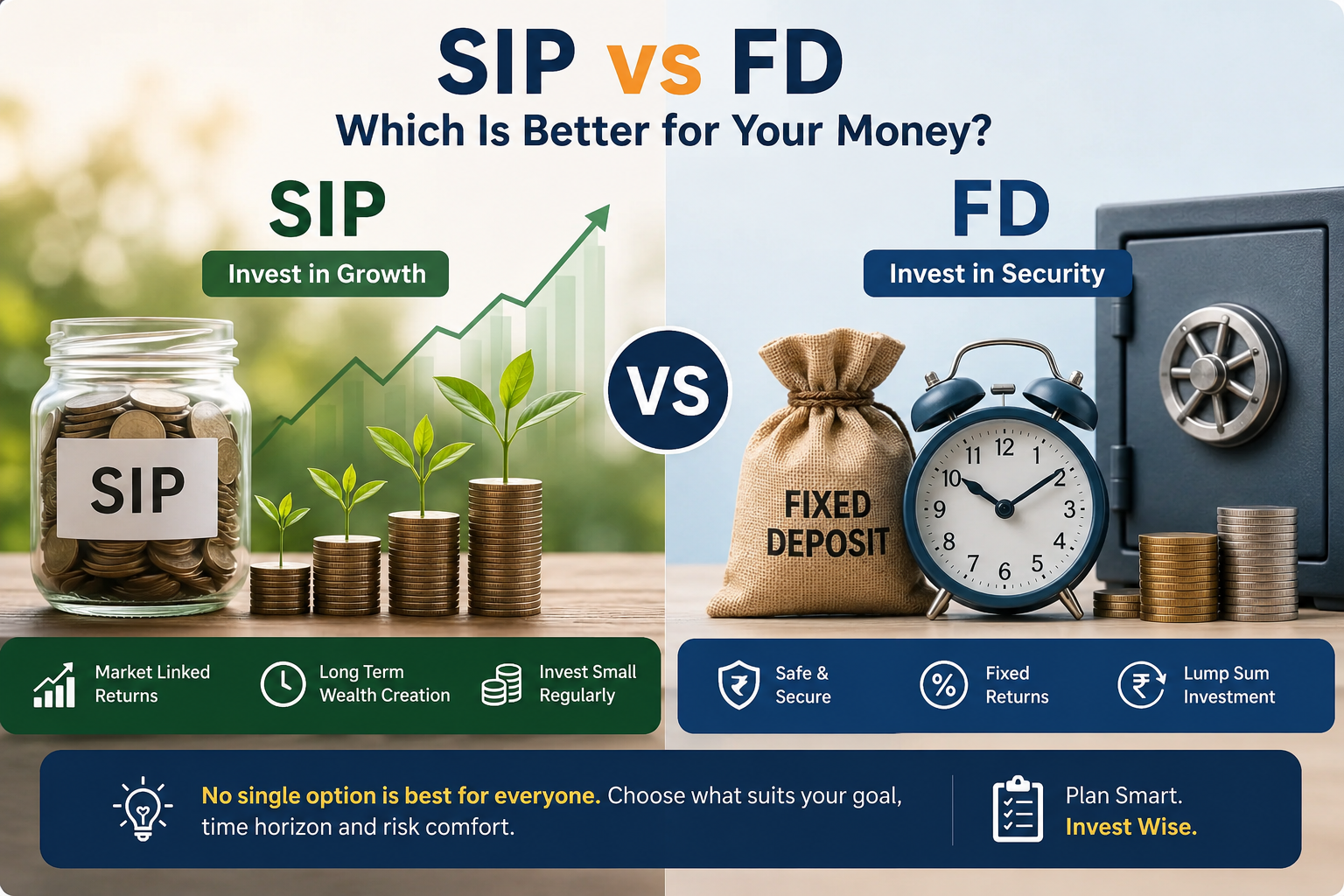
Choosing between a SIP and FD can be confusing, especially when both are popular ways to save and invest money in India.
An FD offers a more predictable way to earn interest, while a SIP gives you a way to invest regularly in mutual funds and potentially grow your money over the long term.
But which one is actually better?
The answer depends on your financial goal, investment period, risk tolerance and when you may need the money.
In this guide, we'll compare SIP and FD in simple terms and help you understand where each option may fit into your financial plan.
What Is a SIP?
SIP stands for Systematic Investment Plan.
It allows you to invest a fixed amount regularly into a mutual fund. Instead of investing a large amount at once, you can invest smaller amounts every month.
For example, if you invest ₹5,000 every month, your total investment over one year would be:
₹5,000 × 12 = ₹60,000
Over a longer period, these regular investments can become a significant amount.
One of the main advantages of SIP is that it encourages regular investing. However, SIP investments are linked to the performance of the mutual fund, so the value can go up or down.
SIP returns are not guaranteed.
If you want to see how your investment could grow under different assumptions, try the Financezy SIP Calculator.
What Is an FD?
FD stands for Fixed Deposit.
With an FD, you deposit a specific amount with a bank for a chosen period. The bank pays interest according to the applicable FD terms.
For example, if you deposit ₹1,00,000 in an FD, the amount can earn interest over the selected tenure.
Unlike a mutual fund investment, an FD does not have the same day-to-day market fluctuations.
For eligible deposits with insured banks, DICGC deposit insurance is available up to ₹5 lakh per depositor per bank, including principal and interest, subject to the applicable rules.
You can use the Financezy FD Calculator to estimate interest and maturity value based on your deposit amount, interest rate and tenure.
SIP vs FD: What's the Difference?
| Feature | SIP | FD |
|---|---|---|
| Full Form | Systematic Investment Plan | Fixed Deposit |
| Investment Type | Mutual Fund | Bank Deposit |
| Returns | Market-linked | Interest-based |
| Market Risk | Yes | No market-linked fluctuation |
| Return Guarantee | No | Based on applicable FD terms |
| Investment Method | Usually regular investment | Usually lump-sum deposit |
| Suitable For | Long-term goals | Short/medium-term savings |
| Value Can Fluctuate | Yes | No market-style fluctuation |
| Liquidity | Depends on mutual fund | Depends on FD terms |
Both have different purposes, so comparing them only on returns doesn't tell the full story.
SIP vs FD: Which Gives Better Returns?
This is probably the first question that comes to mind.
But there is no fixed answer.
A SIP investment in a mutual fund is market-linked. Depending on the type of mutual fund and market conditions, the investment may grow significantly over time, but it can also lose value.
An FD provides interest according to the applicable deposit terms.
So instead of asking:
“Which one gives higher returns?”
ask:
“Which one is more suitable for my financial goal?”
That is a much better way to compare them.
When Is an FD a Better Choice?
An FD may be suitable when you want a relatively predictable savings option and don't want your money to be exposed to market movements in the same way as a mutual fund.
For example, suppose you are saving money for a planned expense in the next one or two years.
You may not want that money to experience large market fluctuations just before you need it.
In such a situation, an FD may be worth considering, depending on the bank, tenure, interest rate and withdrawal conditions.
Before opening an FD, always check the applicable terms and conditions.
When Is SIP a Better Choice?
SIP may be more suitable when you are investing for a long-term goal and are comfortable with market fluctuations.
Some examples include:
- Retirement planning
- Long-term wealth creation
- Children's future education
- Long-term financial goals
The biggest benefit of investing through SIP is that you can start with a relatively small regular amount instead of waiting until you have a large lump sum.
For example, someone who can invest ₹3,000 or ₹5,000 every month can start building an investment habit without needing a large amount upfront.
But remember:
SIP does not guarantee profit.
The result depends on the performance of the underlying mutual fund.
What Happens If You Invest ₹5,000 Every Month?
Let's take a simple example.
Suppose you invest:
₹5,000 per month
for:
10 years
Your total contribution would be:
₹5,000 × 12 × 10 = ₹6,00,000
The final value of your investment could be higher or lower depending on the actual market performance.
For example, a calculator might show an estimated future value based on an assumed annual return. That doesn't mean you will actually receive that return.
You can experiment with different investment periods and assumptions using the Financezy SIP Calculator.
What If You Have ₹5 Lakh?
Now imagine you already have ₹5 lakh available.
Your decision may be different from someone who is investing ₹5,000 every month.
If you need the money for a relatively short-term goal and prefer predictable deposit terms, you may consider an FD.
If the money is for a long-term goal and you are comfortable with market risk, you may consider investing through mutual funds.
There is no single answer that works for everyone.
Your goal and time horizon matter.
SIP vs FD Based on Your Time Horizon
Short-Term Goals
If you need the money soon, protecting the money from significant market fluctuations may be more important.
For short-term goals, consider options that match your need for stability and accessibility.
Medium-Term Goals
For medium-term goals, you have more options.
Your decision should depend on when you need the money, your risk tolerance and your financial situation.
Long-Term Goals
For long-term goals, you may have more time to handle market ups and downs.
This is where SIP-based investing may be considered by investors who are comfortable with market risk.
The longer time horizon doesn't eliminate risk, but it can give you more time to stay invested through different market conditions.
Is SIP Safer Than FD?
No.
SIP and FD have different risk characteristics.
An FD is a bank deposit, while a SIP is a method of investing in a mutual fund.
Because mutual funds are market-linked, their value can increase or decrease.
This means you should not think:
“SIP is safe because I'm investing every month.”
The regular investment method doesn't remove the market risk of the underlying mutual fund.
Can You Invest in Both SIP and FD?
Yes.
You don't have to choose only one.
In fact, using different financial products for different goals can make sense.
For example:
FD → money for a specific short- or medium-term goal
SIP → money for suitable long-term investment goals
This way, each part of your money has a specific purpose.
The right combination depends on your own financial circumstances.
What About an Emergency Fund?
Before focusing heavily on investments, it's worth having a reasonable emergency fund.
An emergency fund is money kept aside for unexpected expenses such as:
- Sudden loss of income
- Medical expenses
- Urgent repairs
- Family emergencies
- Other necessary unexpected costs
You don't want to sell a long-term investment simply because an unexpected bill arrives.
If you're building your emergency savings, read our Emergency Fund in India guide.
SIP vs FD and Inflation
Inflation is another factor that people sometimes overlook.
Suppose your money grows at a certain rate, but the cost of goods and services keeps increasing.
Over a long period, the purchasing power of your money can change.
This is why long-term financial planning isn't only about keeping money safe. It is also about thinking about whether your savings and investments are suitable for your future goals.
There is no guaranteed investment that is automatically best against inflation.
Your goal, time horizon and risk tolerance should all be considered.
What About Tax?
Tax treatment can also affect the actual outcome of an investment.
The tax rules applicable to an FD or mutual-fund investment can depend on several factors, including the type of investment and the applicable tax rules at the time.
This means you shouldn't compare investments only by looking at the headline return.
If you want to estimate your income-tax liability, you can use the Financezy Income Tax Calculator.
The calculator provides an estimate for planning purposes and isn't a substitute for personalised tax advice.
Common SIP Mistakes
Investing Because Someone Promised High Returns
No investment can guarantee that a particular market-linked return will happen.
Always understand what you are investing in.
Stopping SIPs Because of a Short-Term Market Fall
Market values can move up and down.
If you are investing for the long term, understand the investment before making decisions based on short-term movements.
Choosing a Fund Without Understanding It
Different mutual funds have different objectives and risk levels.
Don't select a fund simply because someone recommended it.
Common FD Mistakes
Looking Only at the Interest Rate
The highest interest rate isn't necessarily the only thing you should consider.
Look at the tenure, premature withdrawal conditions, bank and other applicable terms.
Locking Away Money You May Need Soon
If you might need the money unexpectedly, make sure you understand how easily you can access it.
Ignoring Tax
Interest income and the applicable tax treatment should be considered when comparing savings options.
SIP or FD: Which One Should You Choose?
Here's a simple way to think about it.
Consider an FD if:
- You prefer predictable deposit terms
- Your goal is relatively short or medium term
- You don't want market-linked fluctuations
- You want to keep money in a bank deposit for a defined tenure
Consider SIP if:
- Your goal is long term
- You are comfortable with market fluctuations
- You want to invest regularly
- You understand that mutual-fund returns aren't guaranteed
Consider Both if:
You have different goals with different time horizons.
For example, you could keep suitable savings in an FD while investing separately through SIP for long-term goals.
How Financezy Can Help
Making financial decisions becomes easier when you understand the numbers.
Financezy provides free calculators that can help you explore different financial scenarios.
Use the SIP Calculator to estimate potential investment values.
Use the FD Calculator to estimate FD interest and maturity.
If you have loans, the EMI Calculator can help you understand monthly payments and total interest.
For tax planning, you can use the Income Tax Calculator.
These calculators are designed for estimation and educational purposes. Actual results can vary depending on the specific financial product, rates, market performance and applicable rules.
Final Thoughts
So, SIP vs FD — which is better?
There isn't one answer for everyone.
An FD can be useful when you want predictable deposit terms and have a specific savings goal.
A SIP can be useful when you're investing regularly toward suitable long-term goals and are comfortable with market risk.
You can also use both.
The most important thing is to stop thinking about investments only in terms of “which one gives more?”
Instead, think about:
What is my goal?
When will I need the money?
How much risk can I handle?
How easily might I need to access the money?
Once you answer those questions, choosing between an SIP, FD or a combination of both becomes much easier.
Frequently Asked Questions
Is SIP better than FD?
Not always. SIP and FD are different financial products with different purposes. SIP involves investing in mutual funds and is market-linked, while FD is a bank deposit with applicable interest terms.
Is FD safer than SIP?
An FD is not exposed to market fluctuations in the same way as a mutual fund. However, you should still understand the bank, deposit terms, insurance coverage and withdrawal conditions.
Does SIP guarantee returns?
No. SIP is a regular investment method. The underlying mutual fund investment is subject to market risk, and returns aren't guaranteed.
Can I invest in SIP and FD together?
Yes. You can use different financial products for different financial goals. For example, an FD may be considered for certain savings goals while SIP-based investments may be used for suitable long-term goals.
Can I start a SIP with a small amount?
The minimum amount depends on the particular mutual-fund scheme and investment platform. Many SIP options allow relatively small regular investments, but always check the specific scheme's terms.
Should I choose SIP or FD for 10 years?
A 10-year goal gives you a longer time horizon, but the appropriate option still depends on your risk tolerance, financial goals and circumstances. SIP-based mutual-fund investing may be considered for long-term goals by investors who are comfortable with market risk.
Is FD completely risk-free?
An FD doesn't have the same market risk as a mutual fund, but that doesn't mean you should ignore bank-specific terms, deposit limits, withdrawal conditions or applicable deposit insurance.
Important Note
This article is for general educational purposes only and is not personalised financial, investment, tax or legal advice. Mutual fund investments are subject to market risks and returns are not guaranteed. FD interest rates, tax rules and other financial regulations can change. Always check the latest information and consider your own financial circumstances before making an investment decision.